
Table of Contents
Introduction: The Sea That Bore a Kingdom’s Name
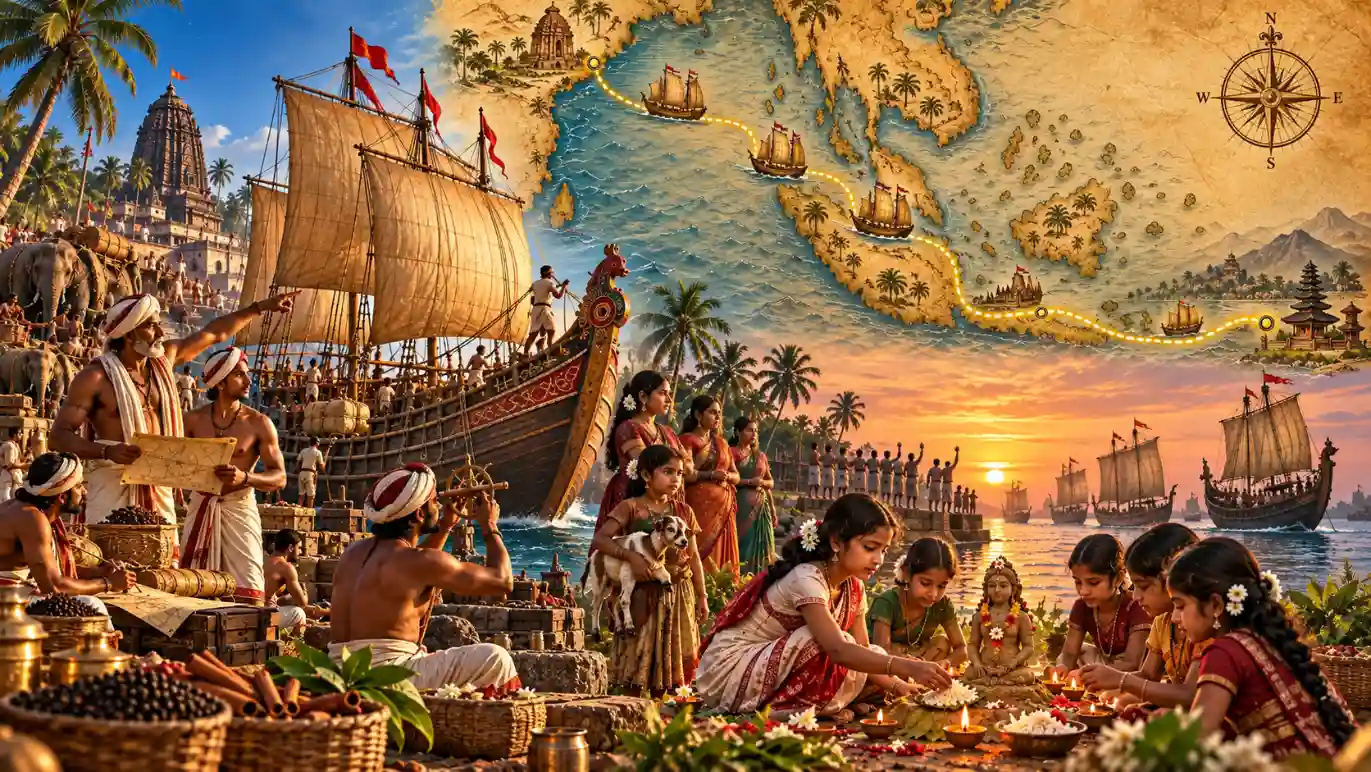
There is a habit among coastal peoples of naming the water after themselves, and for a long stretch of the first millennium the eastern Indian Ocean answered to Kalinga. In Odia tradition and in the regional historiography that grew from it, the northern Bay of Bengal is Kalinga Sagara — the Kalinga Sea. Classical Sanskrit more often uses the older, grander Mahodadhi, the great water-hoard. But the vernacular naming persisted for a reason, and the reason was commercial dominance.
The most cited literary witness is Kalidasa. In the sixth canto of the Raghuvamsa, at the swayamvara of Princess Indumati, the poet’s herald introduces the Kalinga king Hemangada and styles him Mahodadhipati — Lord of the Great Ocean — and Kalinganatha, Lord of Kalinga. The description is not mere flattery of a coastal ruler. In the same passage Kalidasa gives us a detail no courtier would invent: breezes reaching the Kalinga shore carrying the scent of clove blossoms from dvipantara, the islands beyond. Cloves, in the ancient world, grew in one place — the Maluku archipelago of eastern Indonesia. A Gupta-era Sanskrit poet describing spice-scented wind off the Odisha coast is describing, however lyrically, a functioning trade lane.
The archaeology holds up. Ptolemy’s second-century Geography lists a string of ports along this coast — Nanigaina (identified with Puri), Katikardama (Cuttack), Kannagara (Konark) — and the river mouths of the Manada (Mahanadi) and others besides. Ptolemy also names Palur, at the mouth of the Rushikulya, as an international emporium, and the Periplus of the Erythraean Sea refers to the region of Dosarene, famed for its ivory. Excavations at Sisupalgarh, Radhanagar, Manikapatna, Palur and Bidyadharpur have yielded rouletted ware, knobbed ware, Roman amphora sherds, terracotta bullae with Roman portraits and Kushana coinage. Crucially, rouletted and knobbed wares comparable to Odishan finds have also turned up in Bali, Java and Kalimantan. The pots travelled. So did the people who packed them.
This is the deep history that surfaces every Kartika full moon at the Balijatra Cuttack, when a modern city floats paper boats for mariners two thousand years dead.
The Sadhabas and Their Vessels
The men who sailed were the Sadhabas. The word descends from Sanskrit sarthavaha — caravan-leader, the one who conducts the company — and its evolution from overland to seaborne usage is itself a small history of how Kalinga’s commerce turned toward the water. In the layered guild structure of early Indian trade, the shresthi was the financier and guild-master; the sarthavaha-turned-sadhaba was the man who actually moved the goods and bore the risk. A sadhabapua was a Sadhaba’s son, and the term carries in Odia to this day the connotation of a young man bound for somewhere far and dangerous.
Their vessel was the boita. Odia and neighbouring Telugu sources preserve a vocabulary of hull types — boita, pota, danga, nauka, and in Telugu literature kappali, vali, valika and jangu — suggesting a differentiated fleet rather than a single design: coastal lighters, river craft, and deep-water bottoms built for the open crossing.
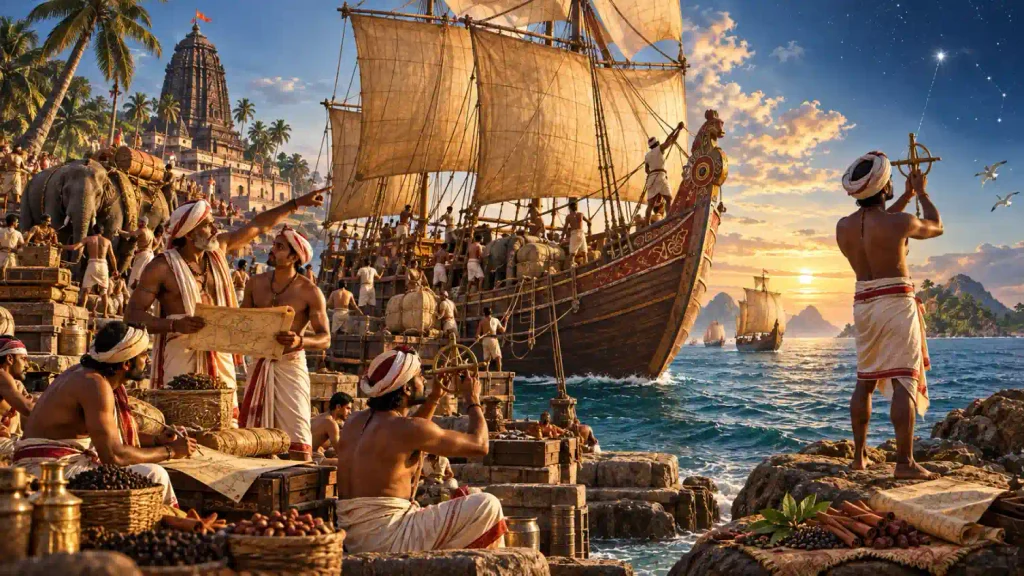
Direct archaeological recovery of a boita hull remains the great missing piece of Odishan maritime studies; no securely dated Kalingan deep-water wreck has yet been excavated and published. What we have instead is iconography. Ship reliefs survive in Odishan temple sculpture, including panels associated with the Bhogamandapa of the Jagannath temple at Puri, and a well-known panel depicting the transport of elephants by sea. Read alongside the far more detailed ship carvings at Borobudur in Java — vessels of the same Indian Ocean tradition, with outriggers, multiple masts and tanja sails — they indicate substantial plank-built craft capable of carrying bulk cargo and livestock across open water.
Two technologies made the voyage possible. The first was the sail the Odia sources call ajhala — the great cloth spread that converted a seasonal wind into distance. The second was navigation by sky and sea-sense: fixed reference on the pole star and circumpolar constellations, dead reckoning, the reading of swell direction, cloud stacks over unseen land, and the behaviour of shore-ranging birds. None of it was written down as a treatise. All of it was carried in the heads of pilots and lost when the trade died.
And the third technology, the one that governed everything, was the calendar. The monsoon over the Bay of Bengal reverses twice a year. From roughly July, the southwest monsoon and the associated circulation favoured the outbound leg; by the full moon of Kartika, in November, the wind had turned decisively to the northeast and would push a laden hull southeast toward the Malay archipelago for months. The return leg waited on the reversal in spring. The Sadhabas did not sail when they wished. They sailed when the ocean permitted, and the entire ritual architecture of Odia coastal culture is built on those two windows.
The Trade Routes to Suvarnadvipa
The destination that dominates Odia memory is Suvarnadvipa, the Golden Isle — most often identified with Sumatra, with Suvarnabhumi applied more broadly to the Malay peninsula and mainland Southeast Asia. Yavadvipa, the Island of Barley, is Java; one of the earliest references to it appears in the Kishkindha Kanda of the Ramayana, where Sugriva directs his search parties toward it — a literary trace of the archipelago’s presence in Indian geographical imagination long before the historical period.
The maritime highway ran in stages. Vessels cleared the Odishan coast from ports strung between the Subarnarekha and the Rushikulya — Tamralipti at the northern edge, Palur at the southern, Pithunda, Kalingapatnam, Che-li-ta-lo (the port recorded by Hiuen Tsang and generally identified with Manikapatna on Chilika), and later Khalkatapatna on the Kushabhadra, a working Eastern Ganga port of the twelfth to fifteenth centuries excavated in the 1980s and 90s. From there the routes ran south along the coast to Simhala (Sri Lanka), or east and southeast across open water toward Burma, the Malay peninsula, the Straits, and thence to Sumatra, Java, Bali and Borneo. A northern branch reached Champa in what is now central Vietnam, and beyond it the China trade; I-tsing, the Chinese pilgrim, returned from Sumatra via Tamralipti, which functioned as the Bay’s principal transit point for monks and merchants alike.
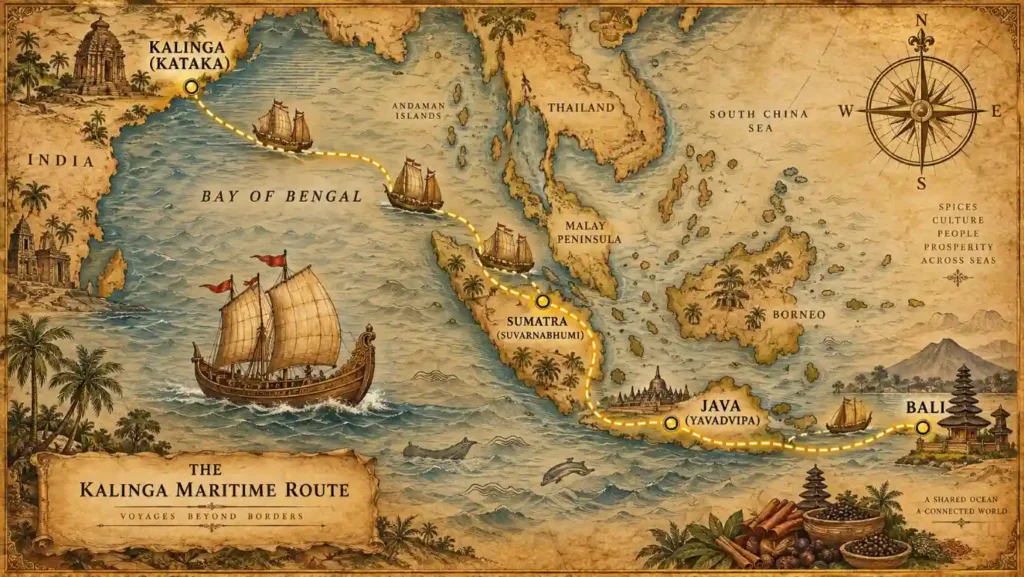
What moved outward: cotton and silk textiles, pepper, cinnamon, cardamom, ginger, betel and areca nut, ivory, worked gold and silver, precious and semi-precious stones from Odisha’s mineral-rich interior — diamond, ruby, sapphire, topaz, emerald, garnet — terracotta and glazed wares, and, in a trade attested in both sculpture and text, war elephants.
What came back: camphor, cloves, nutmeg and mace from the eastern archipelago, sandalwood, tin from the Malay states, gold, Chinese porcelain and ceramics (recovered from Odishan sites), Arabic stoneware, and Ceylonese coinage. Kalinga was not a terminus. It was a node — a place where the eastern archipelago’s spices met the Gangetic hinterland’s cotton and the Roman world’s demand.
The Cultural Footprint in Southeast Asia
Cargo is the least of what crossed. Odia merchant communities settled in the archipelago, and the residue of that settlement is legible in language, ritual and lineage.
The plainest evidence is domestic vocabulary — the words a trader’s household transmits without meaning to. In coastal Odisha a mother is bou and a father bapa; in Bali, bu and bapa. Such parallels are the hardest kind of borrowing to explain by elite contact alone, because kinship terms travel with families, not embassies.
In Bali’s Karangasem regency, a community of brahmanas has historically identified itself as Brahmana–Bauddha–Kalinga, a self-designation preserving a claimed origin in Kalinga. Local Odia tradition, for its part, holds that some two thousand families emigrated to Bali around the third century BCE — variously explained as displacement following the Kalinga War of 261 BCE or as invited settlement. This should be treated as tradition rather than documented fact; the numbers are unverifiable and the dating is loose. What is not in doubt is that a sustained Indic religious and administrative culture took root across Java, Sumatra and Bali, and that Kalinga was one of its principal conduits.
A further hypothesis, still contested among historians, links the Sailendra dynasty of Srivijaya and Java to the Sailodbhava rulers of Kangoda in southern Odisha, on the strength of the name and the Palur emigration route. It is an attractive argument and an unproven one; readers should treat the identification as an open question rather than a settled genealogy.
Where the footprint is unmistakable is in living religion. Balinese Hinduism — Agama Hindu Dharma — retains a strongly Shaivite centre of gravity, with Shiva as presiding deity, alongside Vishnu, Brahma and Ganesha, and observes Shivaratri, Durga puja and Saraswati puja. Bali’s masked performance tradition, the topeng, and the Barong and Rangda dramas that stage the endless contest of order against chaos, sit within the same Indic performance grammar that produced Odisha’s masked Chhau: martial footwork, mythic combat, mask as vehicle for possession rather than disguise.
The most striking survival is calendrical. In south Bali, the custom of Masakapan ke Tukad (also recorded as Masakapam Kepesih) involves floating small vessels into a river or the sea in memory of maritime ancestors. Thailand’s Loi Krathong, Cambodia’s Bon Om Touk and the Lao That Luang festival cluster in the same November window. Across a thousand miles of ocean and two millennia, people descended from a single trading world still put lamps on water at the turn of the monsoon.
The Folklore of Separation
Trade history is usually written from the deck. Odia folklore preserves the other half — the view from the shore, which is a view of women waiting.
The central text is the ballad of Ta’poi (Taapoi), sung during Khudurukuni Osha. The story: Tanayabanta, a wealthy Sadhaba, has seven sons and one much-loved daughter, Ta’poi. The parents die; the brothers sail on a long trading voyage, leaving Ta’poi with their wives. Poisoned by a malicious neighbour’s counsel, the sisters-in-law — all but the youngest, who stays kind — reduce the girl to herding goats on starvation rations. When a goat named Gharamani goes missing, Ta’poi is driven back into the forest at nightfall to find it. There she comes upon village girls performing the puja of Goddess Mangala. She joins them, fasting on the Sundays of Bhadraba, and with nothing else to offer, offers khuda — broken, leftover rice. Her brothers return. The tale’s ending is folkloric and harsh: the wives are punished, the youngest spared.
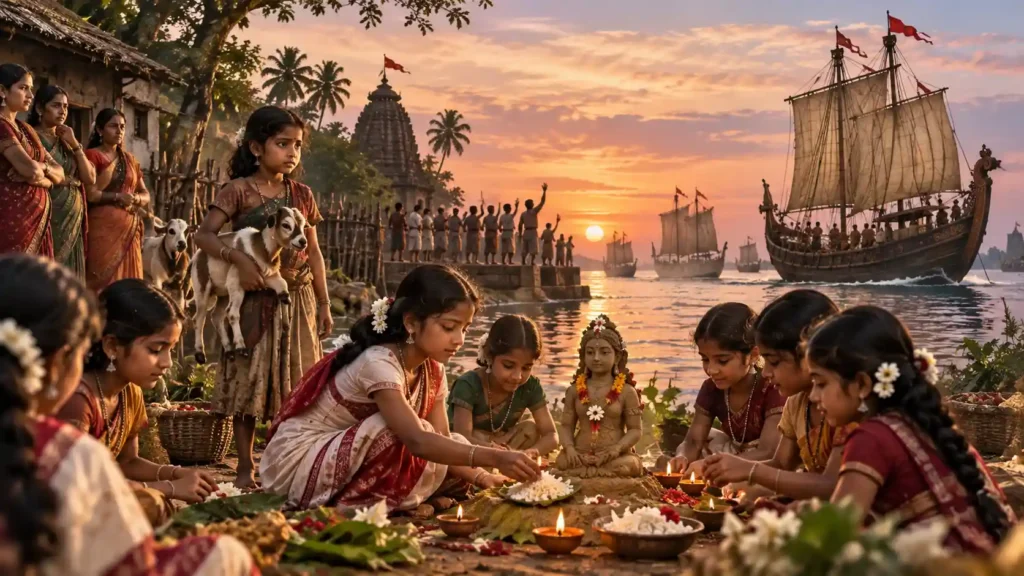
The osha is observed on the Sundays of Bhadraba (August–September), after Gahma Purnima, principally in the coastal districts, by unmarried girls who shape clay or sand images of Mangala on riverbanks and pond edges, recite the Taapoi Kahani, and fast for their brothers’ safety. The festival’s name comes from that humblest of offerings: khuda plus the sense of longing for it. The ballad’s standard Odia points to composition around the sixteenth or seventeenth century, and its Mangala worship to a cult established in Odisha by the twelfth to fourteenth — meaning the surviving text is a late crystallisation of a much older emotional situation.
That situation is the point. A Sadhaba’s voyage removed the men of a household for a year or more, with no guarantee of return. Khudurukuni Osha and Boita Bandana are the same anxiety expressed at opposite ends of the sailing calendar: one prays for the return, the other blesses the departure.
The Ancient Spice & Silk Route of Kalinga
| Port of Origin | Destination | Monsoon Wind Window | Principal Exports | Principal Imports |
|---|---|---|---|---|
| Tamralipti (Subarnarekha mouth / Bengal frontier) | Suvarnadvipa (Sumatra), Malay Peninsula, China trade via Champa | Outbound from Asadha; open-water leg on the NE monsoon from Kartika | Cotton and silk cloth, copper, rice, worked metal | Camphor, cloves, tin, Chinese porcelain |
| Palur (Rushikulya mouth) | Java, Bali, the Straits — Ptolemy’s emporium and the traditional emigration route | NE monsoon, Kartika onward | Pepper, cinnamon, cardamom, precious stones, ivory | Nutmeg, mace, sandalwood, gold |
| Che-li-ta-lo / Manikapatna (Chilika) | Simhala (Sri Lanka), Burma, Southeast Asia | Coastal legs year-round; ocean legs seasonal | Textiles, terracotta and glazed ware, betel and areca nut | Ceylonese coin, Arabic stoneware, spices |
| Pithunda / Kalingapatnam (southern Kalinga) | Simhala, peninsular ports, Malay coast | NE monsoon window | Elephants, gemstones, ivory, spices | Pearls, gold, aromatics |
| Khalkatapatna (Kushabhadra, Eastern Ganga era, 12th–15th c. CE) | Indonesia and China east; Arabian ports west | NE monsoon; return on the spring reversal | Textiles, temple goods, spices | Porcelain, glazed ceramics, glass |
| RETURN LEG — all ports | Homeward from the archipelago | Magha to Baisakha (approx. Jan–May), on the reversing monsoon | — | Full cargo, and the crews who survived |
Geographical Trajectory of an Ancient Boita Expedition
| Leg & Distance | Navigational Checkpoint | Operational Objective |
| 01 (0 km) | Kataka (Mahanadi Riverbed) | Inland trade gathering, boita construction, and river descent. |
| 02 (~150–350 km) | Manikapatna & Palur | Estuarine piloting and provisioning; Kartika Purnima launch. |
| 03 (~800 km) | Kalingapatnam (Andhra Coast) | Coastal tracking; open-water branch split toward Sri Lanka. |
| 04 (~1,600 km) | Bay of Bengal Crossing | Deep-sea dead reckoning; secondary routes to Myanmar and Champa. |
| 05 (~2,600 km) | Malay Peninsula (Suvarnabhumi) | Transshipment hub; trading cotton textiles for tin and gold. |
| 06 (~3,200 km) | Suvarnadvipa (Sumatra) | Srivijaya emporiums; acquisition of camphor and black pepper. |
| 07 (~3,900 km) | Yavadvipa (Java) to Bali | Final port calls, temple patronage, and cultural integration. |
Kartika Purnima and ‘Aa Ka Ma Boi’: Decoding the Dawn Song
At first light on Kartika Purnima, as the miniature boats go onto the water, the line recited is:
Aa Ka Ma Boi, pana gua thoi.
The second half is transparent: pana gua thoi — “having placed betel leaf and areca nut,” the offerings loaded into each toy hull. The first half is a mnemonic, and this is where the sacred meets the technical.
The prevailing reading takes the four syllables as the initial sounds of four months of the Odia calendar: Asadha, Kartika, Magha and Baisakha. These are not arbitrary. Asadha through Kartika was the season of outgoing voyage; Magha through Baisakha the season of return. The chant is, in other words, a compressed sailing almanac — the four hinge-months of the Bay of Bengal’s wind system, preserved as liturgy after the fleets that needed them were gone.
Other readings circulate. Some scholars parse the syllables differently or treat the phrase as a corrupted invocation whose original sense is irrecoverable, and it is honest to say the etymology is not settled. What is not disputed is the function: an oral device that encoded when it was safe to sail, taught to children, sung by women, and carried across at least a thousand years by people who had every practical reason to remember it correctly.
The ritual physics is equally deliberate. The boat is made of what the delta yields and the river can dissolve — banana sheath, sholapith, paper, cork. It carries fire on water, the lamp in the hull, a compact image of the voyage itself: something fragile, lit, and sent out. It is released before sunrise, in the hour the fleets actually weighed anchor to catch the land breeze. And it is released downstream, never retrieved. Whether it sinks or reaches the sea is not the observer’s business — which is precisely the condition under which every Sadhaba’s family lived.
For the modern shape this ritual takes on the Mahanadi’s sands, see our guide to the Cuttack Baliyatra festival and its home city, the millennium city of Kataka.
Frequently Asked Questions
1. Who were the Sadhabas of Kalinga? The Sadhabas were the merchant-mariners of ancient Kalinga (modern Odisha). The name derives from the Sanskrit sarthavaha, meaning caravan-leader. Operating beneath guild financiers known as shresthis, they commanded ships called boitas and sailed the Bay of Bengal to Sri Lanka, Myanmar, the Malay Peninsula, Sumatra, Java, Bali and Champa from roughly the mid-first millennium BCE through the thirteenth century CE.
2. Why is the Bay of Bengal called Kalingasagara? Because Kalinga’s mariners dominated its northern trade lanes for centuries, the sea acquired the kingdom’s name in regional usage — Kalinga Sagara. Classical Sanskrit sources more commonly use Mahodadhi. Kalidasa’s Raghuvamsa reflects the same reputation by titling the Kalinga king Mahodadhipati, Lord of the Great Ocean.
3. What did Kalinga trade with Bali, Java and Sumatra? Kalinga exported textiles, pepper, cinnamon, cardamom, ivory, precious stones, terracotta wares, betel and areca nut, and elephants. In return it received camphor, cloves, nutmeg, sandalwood, tin, gold, Chinese porcelain and Ceylonese coin. Archaeological corroboration includes rouletted and knobbed ware of Odishan type recovered in Bali, Java and Kalimantan.
4. What is the historical basis of Boita Bandana? Boita Bandana is the surviving departure rite of the Sadhaba fleets. Kartika Purnima marks the turn of the northeast monsoon, the wind that carried loaded ships southeast toward the archipelago. Families gathered at the water before dawn to bless the departing vessels; the modern practice of floating miniature lamp-bearing boats preserves that ceremony, and finds close parallels in Bali’s Masakapan ke Tukad and Thailand’s Loi Krathong.
A trade route is only ever as durable as the people who remember it. Kalinga’s fleets stopped sailing centuries ago. The song that told them when to go is still sung at dawn, by children, on a riverbed in Cuttack.