
Table of Contents
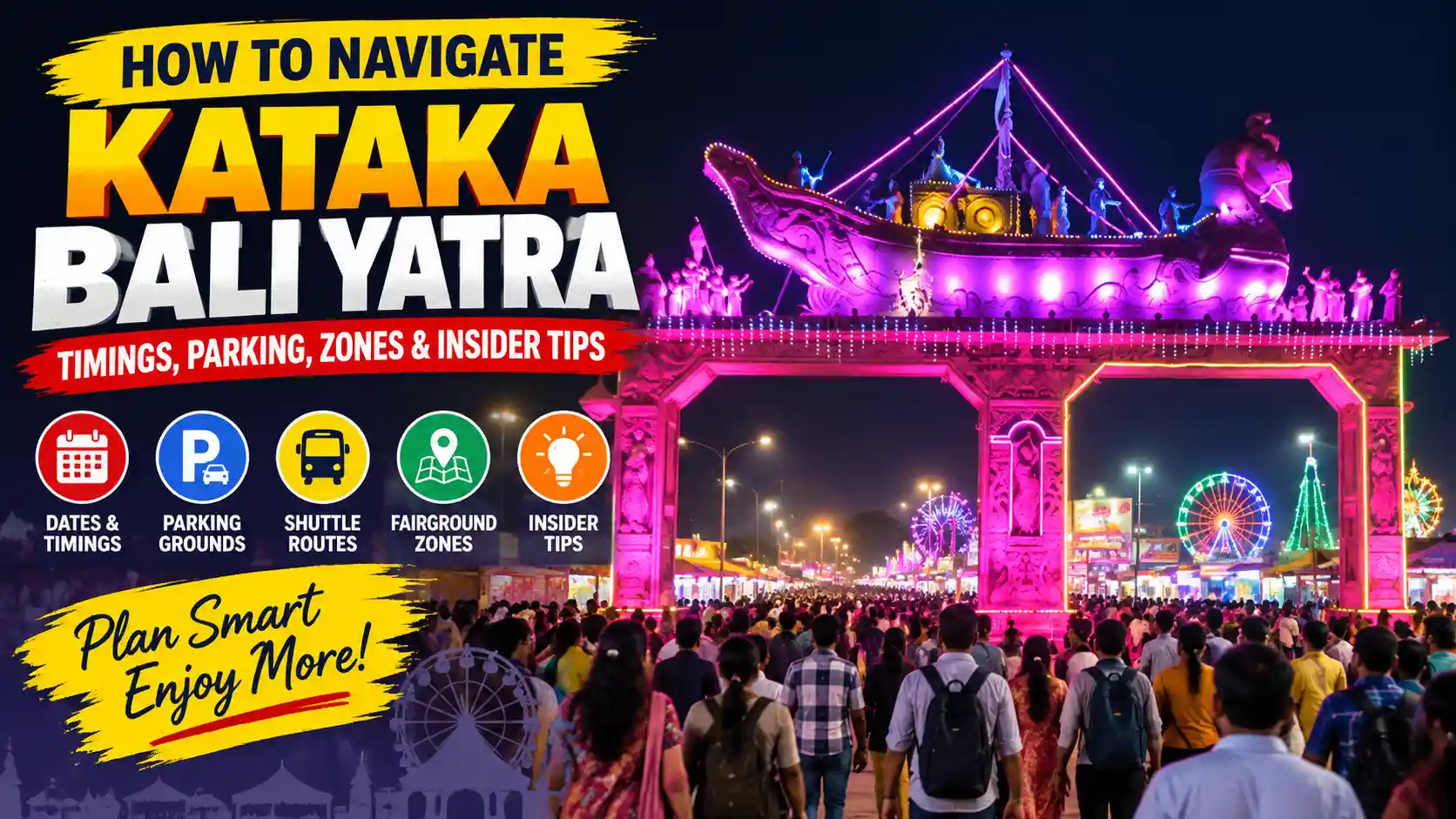
Most people who have a bad time at Bali Yatra have the same bad time: they drive toward the fairground at seven in the evening, hit a blocking point they didn’t know existed, spend forty minutes reversing out of a lane full of pedestrians, park two kilometres from where they wanted to be, and arrive tired and annoyed at the busiest possible hour.
All of that is avoidable. Here is how.
Read this first. The Cuttack Commissionerate Police and the district administration re-issue the traffic plan, parking grounds and blocking points every single year, and the ground layout changes with the acreage allotted. Everything below reflects the pattern of recent editions and is reliable as a framework — but confirm the current year’s advisory before you set out. It is published a few days before the fair opens and carried by every Odia news outlet. As of late September 2026 the 2026 advisory has not been issued, so the parking grounds and blocking points below remain the recent-editions pattern rather than this year’s confirmed plan.
Fair Essentials
Dates. Balijatra Cuttack 2026 runs from Tuesday, 24 November to Tuesday, 1 December — eight days. The opening falls on Kartika Purnima; the closing date was announced by the Kataka Collector rather than inferred, so it is firm rather than estimated. Treat an extension as possible but not planned: the 2025 edition was extended by one day midway through its run.
Daily hours. Stalls generally open around 10:00–11:00 AM and run late. Cultural programming on the main stages has in recent editions been extended to 11:00 PM. The grounds wind down after that.
The one exception. Opening morning is different. Boita Bandana at Gadagadia Ghat happens before sunrise — be at the water by 4:00 AM on Kartika Purnima. This is a separate trip from the fair proper, and worth making.
Entry. Free. There is no gate ticket. Some editions have offered paid passes for reserved seating at headline cultural events; everything else is open access.
Performing. The cultural programme is not open booking — registered institutions apply to the District Culture Council months ahead, and applications for the 2026 edition close on 20 October 2026. See the cultural troupe application guide.
Crowd curve.
- 10 AM – 2 PM: Quietest. Some stalls still setting up.
- 2 PM – 4 PM: The sweet spot. Everything open, room to move, daylight for inspecting goods.
- 4 PM – 6 PM: Filling fast. Traffic restrictions kick in at 2 PM and the inbound flow builds.
- 6 PM – 10:30 PM: Peak. On weekends and the final days this becomes shoulder-to-shoulder movement on the main avenues.
- After 10:30 PM: Thinning, but the exit crush is its own event.
Fairground Geography: Upper vs Lower
This confuses first-timers more than anything else, so get it straight before you travel.
Lower Bali Yatra Ground is the Mahanadi riverbed itself, near Gadagadia Ghat — the vast flat sandbed the river exposes after the monsoon. This is the commercial heart: stalls, food streets, ORMAS pavilions, amusement rides. In the 2025 edition the administration confined commercial stalls to the Lower ground entirely, building roughly 1,670 plots across about 60 acres, of which a reported 1,420 were booked. For 2026 that confinement has been undone: registration opened on 10 October 2026 for 1,452 Lower-ground plots, sized 10×10 to 25×40 feet, with the Upper ground back in commercial use alongside it.
Upper Bali Yatra Ground sits above the embankment, nearer Barabati Stadium and the fort. Its use varies year to year — in some editions it has carried cultural stages and additional stalls; in others it has been designated two-wheeler parking (Zone I and Zone II) with commercial activity kept off it. In 2022 the fair spread across roughly 100 acres using both grounds. For 2026 the Upper ground returns to commercial use: the administration has laid out 592 stalls across roughly 1.93 lakh square feet, divided into eleven blocks for crowd management, with lighting, drainage, internal roads and parking built in, and opened registration against them on 10 October 2026. The layout is zoned — a food zone of 120 stalls (40 at 20×15 feet, 80 at 10×15 feet), about 15,000 sq ft for amusements, roughly 30,000 sq ft for government departments, about 15,000 sq ft for corporate and industrial exhibitors, roughly 10,000 sq ft for MSMEs, about 5,000 sq ft for the Social Welfare Office and some 2,700 sq ft as a vending zone for small traders. The Dahibara Aludum Haat moves here.
The Upper ground and the courts. The Upper ground has been through the Orissa High Court more than once, which is why its status seems to wobble from year to year. The Court has not prohibited Bali Yatra there: in October 2025 it clarified that no restriction exists on holding the fair at Killa Maidan, and that the choice between the Upper ground and the riverbed is the administration’s to make on practical grounds. What the Court has directed is how the fair is run — noise control, drinking water for vendors, proper space for temporary stalls, sanitation, roads built for crowd movement, vendors kept off footpaths, and an ambulance corridor. So when the configuration changes between editions, read it as an administrative decision rather than a judicial one.
Why it matters: in some years “the Upper ground” means the two-wheeler parking zone rather than the fair. For 2026 it is fairground, not parking — commercial plots there went to registration on 10 October 2026, which inverts the advice that held in 2025. Confirm which ground your destination is on against the current year’s advisory; this is precisely the detail that changes.
Getting There & Transit
From Bhubaneswar / Biju Patnaik International Airport
The airport is roughly 30 km from the fairground, about 45–75 minutes depending on traffic.
- By car/taxi: Route via Nandankanan – Baranga – Trisulia – Netaji Setu. In recent years, vehicles on this approach were required to turn left at Bellevue Chhak (Judicial Academy), proceed via CDA-11, and park at Bhuasuni Ground or Krushak Bazaar Ground, then take a shuttle. Do not plan to drive to the gate.
- By train: Frequent local and express services run Bhubaneswar–Cuttack in about 25–40 minutes. During the fair this is comfortably the least stressful option.
- By bus: Mo Bus and state buses connect the two cities regularly.
From Cuttack Railway Station
The station is roughly 3–5 km from the fairground. Auto-rickshaws are plentiful. Expect surge pricing and refusals at peak hours — agree the fare before boarding, or insist on the meter. Many autos will drop you only at a blocking point, which is normal and not a scam; walk the rest.
Shuttles and Mo Bus
The administration runs a dedicated shuttle fleet — more than 50 buses in the 2025 edition — connecting the peripheral parking grounds to the fair. The long-running shuttle spine has been Bhuasuni Parking → Cantonment Police Station, a short walk from the grounds. Mo Bus (CRUT) services have also been folded into the plan in recent years.
Insider tip: the shuttle is not a fallback. It is the fastest way in. Park peripherally on purpose.
Parking & Traffic Management
What is confirmed for 2026. Two decisions are already on the record. Half of Chatta Road (reported also as Chahata Road) has been earmarked for special parking, and additional bus services will run between the parking grounds and the fair — an expansion of the shuttle spine rather than a replacement for it. The district administration has also put the city’s Balijatra parking sites out to auction under a tender that ran from 25 September and closed on 8 October 2026. The district administration had not published the outcome as of 13 October, so the operators and the exact site list for this edition are still being settled. The full parking map, with grounds, rates and blocking points, arrives with the Commissionerate Police advisory a few days before the fair opens. Official tender notice: Kataka District Administration.
Restrictions come into force at 2:00 PM daily and stay in force until the crowd disperses. Emergency vehicles are exempt. Violations have attracted penalties in the range of ₹500–₹1,000 under Section 96 of the Odisha Urban Police Act, 2003.
Designated parking grounds (recurring across recent editions)
| Ground | Typically for | Approach |
|---|---|---|
| Bhuasuni Ground (Maa Bhuasuni) | Cars, two-wheelers — the main lot | Bhubaneswar side via Bellevue Chhak → CDA-11 |
| Krushak Bazaar Ground | Cars | Same approach as above |
| Biju Patnaik Park | Cars | Via CDA-11 |
| Gora Kabar Ground | Cars, two-wheelers | Athagarh/Banki side; Chahata approach |
| Christian Ground (Christian Padia) | Cars, two-wheelers | Deer Park / Chahata approaches |
| Daya Ashram Ground | Two-wheelers | Satichaura → Shelter → Kanika Chhak |
| Upper Bali Yatra Ground, Zones I & II | Two-wheelers only | Satichaura route |
| Silver City Boating Club Lots 1–4 | Cars | Ring Road approach |
| Matamatha / Chief Justice Residence lots (A–E) | Cars | Jobra / Matamatha side |
Approach routes by direction
- From Bhubaneswar (Nandankanan/Trisulia/Netaji Setu): left at Bellevue Chhak → CDA-11 → Biju Patnaik Park → park at Bhuasuni or Krushak Bazaar → shuttle.
- From Athagarh/Banki (Naraj Bridge, Madhusudan Bridge): park at Bhuasuni, Gora Kabar or Christian Ground → shuttle.
- From Satichaura (Shelter, Kanika Chhak): two-wheelers to Daya Ashram or Upper Bali Yatra Zones I–II.
- From Chahata Square: cars and autos to Bhuasuni, Gora Kabar or Christian Ground.
Blocking points — where you will be turned around
Deer Park Square and Madhukunj Park Square have been closed to fairground-bound traffic. Chandi Chhak via Cambridge School has been restricted for four-wheelers and autos. Traffic from Jobra/Matamatha has been stopped near the Chief Justice Residence. From Grinar Hotel Square, vehicles have been turned toward the Ring Road rather than Madhusudan Statue.
The single most useful habit: decide your parking ground before you leave, not when you hit the barricade.
Check for the app. The administration has previously run an ‘AMA BALIYATRA’ mobile app giving live traffic and parking-availability information. Check whether it is active for the current edition — it removes most of the guesswork.
Fairground Navigation Matrix
Safety, Eco-Consciousness & Accessibility
Plastic and eco-offerings. Recent editions have pushed hard toward zero single-use plastic, with recycling units, solar lighting and a stated zero-waste ambition. On the ritual side, the shift is to biodegradable boitas — paper, banana sheath, sholapith and clay lamps rather than thermocol. The 2025 edition promoted tens of thousands of eco-friendly boats for Boita Bandana. Carry a cloth bag and a refillable bottle. If a vendor offers thermocol, ask for paper.
Food safety. In 2025 the administration made FSSAI certification mandatory for all food stalls, with monitoring teams checking compliance. Look for the certificate displayed at the stall.
Rides and the amusement zone. The 2026 edition is being planned with a tighter ride regime after a 70-foot tower ride malfunctioned at the 2025 fair and left sixteen people stranded. KalingaTV reports the Meena Bazar Association — the ride operators’ own body — barring the “Hammer” and “Single Tower” rides and excessively old equipment this year, with a technical team inspecting rides before installation and the administration pressing for adequate spacing between them. Treat that as the operators’ stated intention rather than a published rule: no district notice naming banned rides has been issued. If you are taking children on rides, look for the inspection marking, and give the tall rides a miss on peak nights when queues press up against the machinery.
On-ground help. Expect police assistance booths, a substantial Commissionerate deployment, first-aid and medical kiosks, fire and disaster-response teams, lost-and-found / public announcement desks, drinking water points and temporary sanitation blocks. Locate the nearest police booth when you arrive, not when you need it.
Children. The single most common incident at the fair is a separated child. Write your phone number on your child’s arm or slip a card in their pocket. Agree a fixed meeting landmark — a specific stage or gate, not “near the food stalls.”
Accessibility. Be realistic. The Lower ground is a riverbed — compacted sand and levelled earth, not paving. Temporary ramps and accessible toilets have been provided in recent editions, but wheelchair movement is genuinely difficult after 5 PM in crowd density. Visit between 11 AM and 3 PM if mobility is a concern, use a companion, and ask a police booth to direct you to the firmest access route. Prams face the same problem; a carrier is easier than a stroller.
Nearby Attractions to Pair With Your Visit
Barabati Fort ruins — minutes from the Upper ground. The moat, gateway and the earthen mound of the nine-storeyed palace, protected by the ASI. Ten minutes’ walk, a thousand years of context. Read the full story in the millennium city of Kataka.
Odisha State Maritime Museum, Jobra — the essential pairing. Housed in the restored colonial-era Jobra boat workshop on the Mahanadi, roughly 4 km from Cuttack Railway Station, with ten galleries covering maritime history, boat and shipbuilding, navigation and Odisha’s coastal monuments, plus an aquarium and 3D show. Typically 10 AM–5 PM, closed Mondays, with a nominal entry fee; confirm current timings and ticketing before going. See it before the fair and the whole festival makes more sense — background in the history of ancient Kalinga’s maritime trade.
Netaji Birthplace Museum (Janakinath Bhawan), Oriya Bazar — Subhas Chandra Bose’s restored ancestral home, about 5 km from the station. Typically 10 AM–5 PM, closed Sundays, entry around ₹10 for adults.
Add Cuttack Chandi Temple and Qadam-i-Rasul if you have a morning free.
Visitor Logistics Cheat-Sheet
| Time Slot | Crowd Level | Best For | Pro Tip |
|---|---|---|---|
| 4:00–6:00 AM (Day 1 only) | Very high but calm | Boita Bandana at Gadagadia Ghat | Walk in. Buy your boat and diya near the ghat. |
| 10 AM–12 PM | Low | Museums, Barabati Fort | Some stalls still opening; do the sightseeing now. |
| 12–2 PM | Low–moderate | Unhurried browsing | Last window before traffic curbs start at 2 PM. |
| 2–4 PM | Moderate | Serious shopping — handloom, ORMAS, crafts | The single best slot. Daylight, space, talkative artisans. |
| 4–6 PM | Rising fast | Early food run | Thunka puri is best from the first frying. |
| 6–8 PM | High | Lights, atmosphere, photos | Enter from the quiet end of the food street. |
| 8–10:30 PM | Peak | Cultural stages, full carnival | Don’t attempt shopping. Keep children in hand. |
| 10:30–11:30 PM | Dispersal crush | Leaving | Exit by 9:15 PM or after 11:15 PM — never in between. |
Universal pro tips: wear closed shoes you don’t mind losing to sand · carry cash and a UPI-enabled phone · fully charge your phone and bring a power bank · book Cuttack hotels weeks ahead · park peripherally and take the shuttle · fix a rendezvous landmark before entering.
Frequently Asked Questions
1. Is there a parking charge, and how much? Designated grounds are operated under the administration’s plan and have generally levied only nominal charges, with rates set fresh each year — expect a small two-wheeler fee and a modest four-wheeler fee rather than anything substantial. The real cost of parking badly is time, not money: parking outside a designated ground risks a penalty in the ₹500–₹1,000 range under the Odisha Urban Police Act. Confirm the current year’s rates in the published advisory.
2. Is Bali Yatra wheelchair accessible? Partially. The Lower ground is compacted riverbed sand, and while temporary ramps and accessible toilets are provided, surfaces are uneven and evening crowd density makes independent wheelchair movement very hard. Visit between 11 AM and 3 PM with a companion, and ask at a police assistance booth for the firmest route in.
3. Can I pay by card or UPI, or do I need cash? Carry both. UPI is widely accepted now, including at many small stalls, but network congestion on the grounds is real — with lakhs of phones in one place, payments fail exactly when you need them. Keep enough cash for food, autos, parking and small purchases, and treat UPI as the backup rather than the plan.
4. What are the peak rush hours, and when should I actually go? Peak is 6:00 PM to 10:30 PM, worst on weekends and in the fair’s closing days. Go 2:00–4:00 PM on a weekday to shop properly, or arrive around 5:30 PM if you want the lights without the worst of the crush.
5. Where exactly do I park if I’m driving from Bhubaneswar? Under the recent pattern: take the Nandankanan–Trisulia–Netaji Setu route, turn left at Bellevue Chhak, go via CDA-11, and park at Bhuasuni Ground or Krushak Bazaar Ground, then take the shuttle in. Do not attempt to drive to the fairground gate after 2 PM — you will be turned back at a blocking point. Verify against the current year’s police advisory before you leave.
The fair rewards people who arrive early and leave before the rush. Everything else — the food, the crafts, the stages — is the same for everyone. Timing is the only real advantage available, and it’s free.