
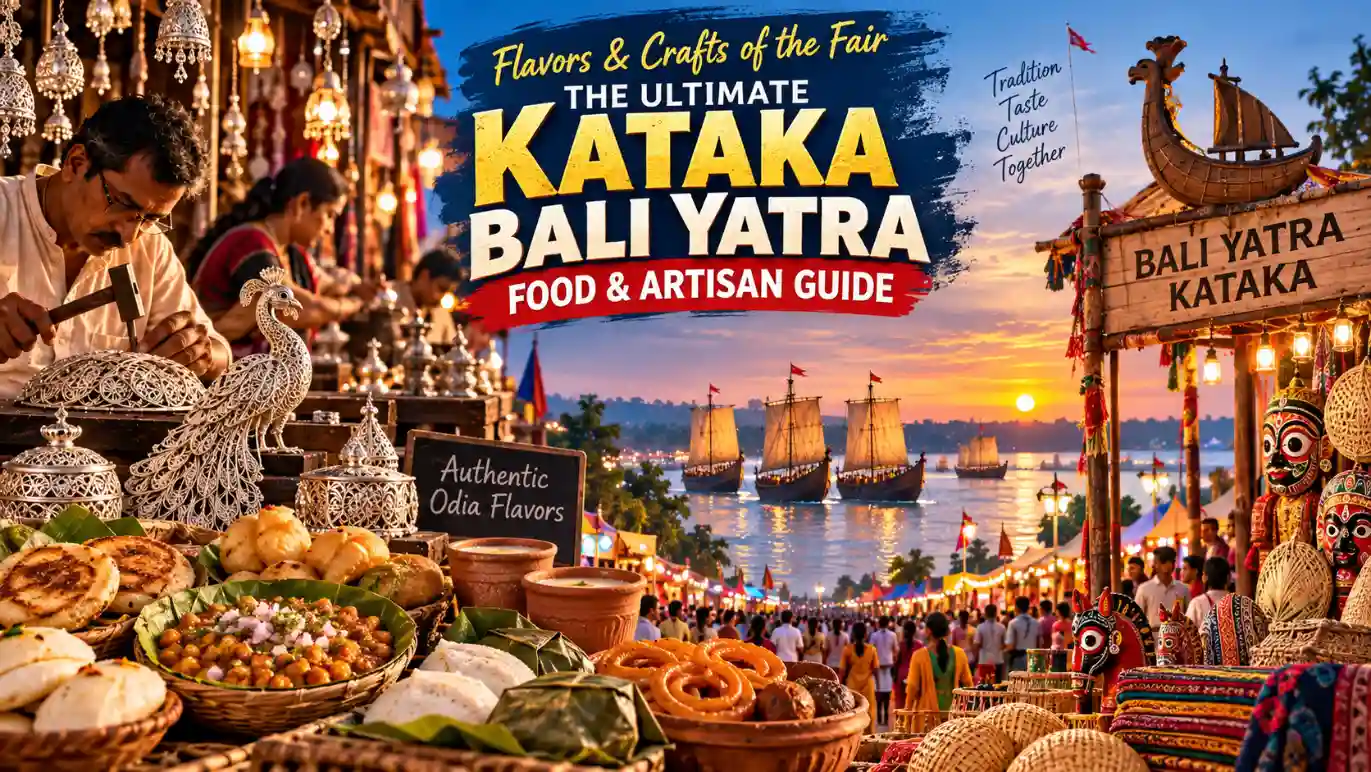
Table of Contents
At about half past five on a November evening, the Bali Yatra grounds change smell. The dust and diesel of the afternoon give way to something layered and specific: hot fat, cumin blooming in a tempering pan, the sharp lactic tang of curd cut with mustard oil, caramelising sugar somewhere off to the left, and under all of it the cold river coming off the Mahanadi. If you have grown up in Cuttack, that smell is not a description. It is a date on a calendar.
Why Eating Here Is the Point
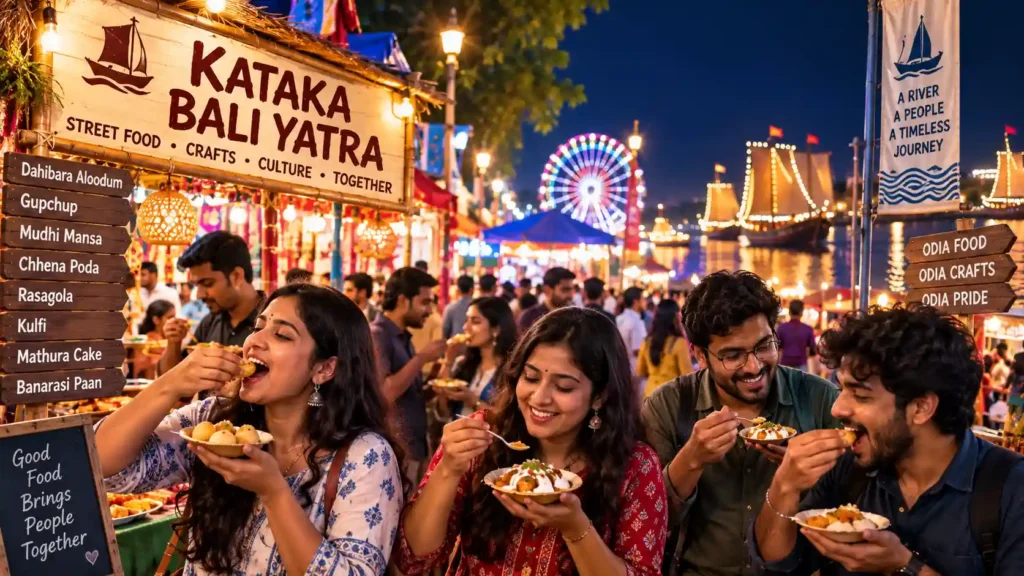
Odias will tell you, without irony, that some people go to Bali Yatra only to eat. This is true and it is not a joke. For a state whose food culture is intensely regional — a sweet that belongs to one village, a weave that belongs to one river valley — the fair is the one week a year when all of it stands in a row on the same sandbank. A family from Koraput can eat Cuttack’s dahibara; a Cuttacki can buy Baripada’s mudhi and Nayagarh’s chhena poda without leaving the riverbed.
There is also the matter of exclusivity. At least one dish here — thunka puri — is essentially unavailable the rest of the year. Its return is a seasonal event in the way the first mango is elsewhere. That combination of scarcity, memory and cold weather is why the food lanes at Bali Yatra are not a concession stand attached to a trade fair. They are, for a great many visitors, the reason for the trip. The wider history of that appetite lives in the millennium city of Kataka, which calls itself the street food capital of Odisha and is not much challenged on the claim.
The Iconic Duo
Cuttack Dahibara Aloodum
Start here, because Cuttack invented the combination and everything else is a variation on it. The pairing is traditionally traced to Bidanasi, in old Cuttack, where vendors working near Barabati Fort first put the two halves together.
The bara. Washed urad dal — black gram — soaked overnight, ground to a batter, and deep fried into soft, porous rounds. Not the crisp South Indian vada. The Cuttacki bara is made to drink liquid.
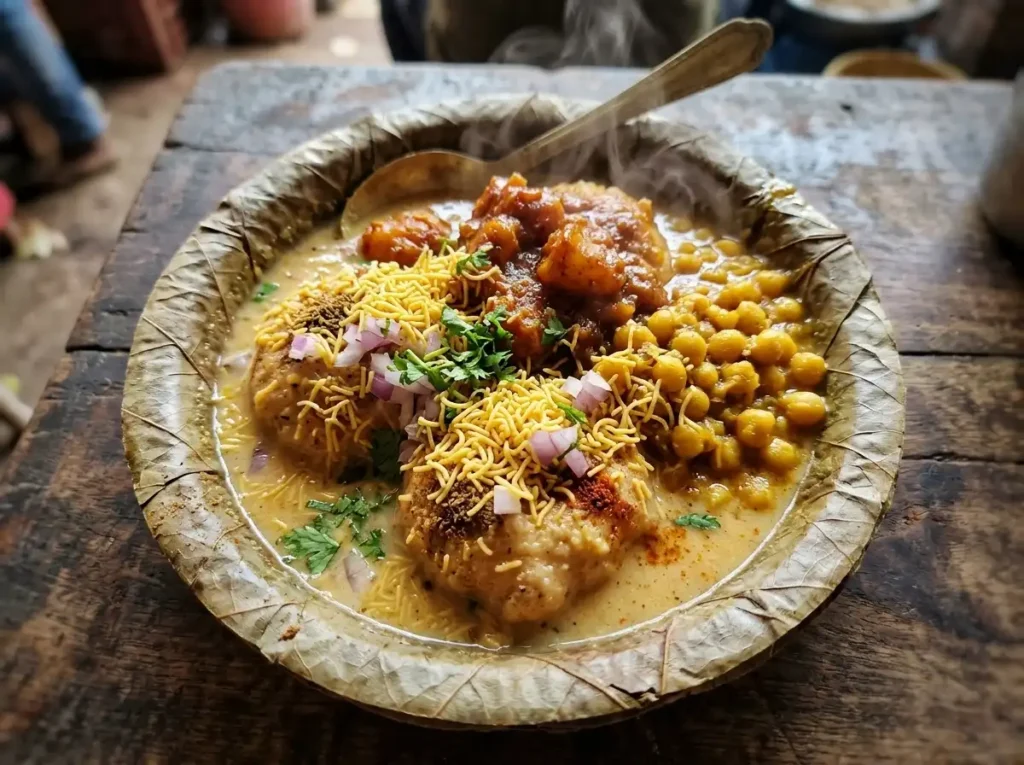
The soak. This is the technical heart of the dish and the part outsiders get wrong. The baras are first plunged into plain water to relax them, then transferred into a thin, spiced curd water — dahi loosened almost to the consistency of buttermilk, seasoned and finished with a tempering of mustard seeds and curry leaves. It is deliberately light. A heavy, creamy curd would collapse the balance with what comes next. (Note for the pedants: this spiced dahi-pani is not torani, which properly means the fermented rice water drawn off pakhala. Different liquid, different dish.)
The aloodum. Slow-cooked baby potatoes in a dark, oil-slicked, unapologetically hot masala — mustard, garlic, chilli, cumin, a Cuttack-specific heat that arrives late and stays.
The ghuguni. White or yellow dried peas, soaked and boiled soft, spiced and slightly soupy, ladled over the top.
The finish. Raw chopped onion, a fistful of coriander, a shower of fine jhuri sev, dry spice powders, sometimes lemon.
What you get is a bowl in four temperatures and five textures at once: cold curd, hot curry, soft bara, crisp sev, sharp onion. It is eaten standing up, with a spoon, in about ninety seconds. Cuttack observes 1 March as Dahibara Aloodum Dibasa, and generational vendors — Raghu’s stall being the name most often invoked — have fed three generations of the same families.
Thunka Puri and Chhena Tarkari
The fair’s own dish. You will not easily find it in Cuttack in March.
A thunka puri is enormous — a stiff maida dough rolled far wider than any ordinary puri, slid into bubbling fat (ghee in the traditional preparation, and the aroma is the giveaway when it is), where it balloons into a golden dome and comes out shatteringly crisp at the edges and chewy at the centre. It is sold hot enough to hurt.
Its partner, chhena tarkari, is what makes the plate. Fresh chhena is set, cut and fried into golden nuggets, then simmered in an onion–tomato gravy carrying a distinct sweetness against the spice — that sweet-savoury pull is characteristic and, for anyone raised on it, instantly nostalgic. You tear the puri, scoop the chhena, and understand within one mouthful why people queue.
Eat it early in the evening. The best puris come out of the first hours of frying, before the fat has been worked all night.
Extended Street Food Delights
Omfed rabidi. The state dairy cooperative’s stall reduces milk down to a thick, grainy, cardamom-scented rabidi served cold in small cups. In November, on the riverbank, it is the single most restorative thing on the grounds.
Kulfi. Dense, unaerated, set on a stick or in a matka, cut with a wire. Malai and pista dominate.
Bara–ghuguni. The workhorse of Odia fair eating and quite distinct from dahibara: a plain bara, hot ghuguni ladled over, onion, lemon, a scatter of namkeen. Cheap, filling, everywhere.
Chaat and gupchup. Odisha’s gupchup is smaller and sharper than the northern golgappa, with a thinner, more aggressively sour water. Order it and do not negotiate the number.
Chops, lanka chop and Mathura cake. Deep-fried batter-coated everything: potato chops, vegetable chops, the mirchi bajji locals call lanka chop, and Mathura cake, a Cuttack fair fixture whose name promises more than the plain, sweet, fried square delivers — which is precisely why people keep buying it.
Mudhi mansa and chakuli pitha. Puffed rice with a fierce mutton curry, a Mayurbhanj and Baripada speciality; and soft fermented rice-batter pancakes.
The sweets. This is a winter fair and Odisha’s sweet canon shows up in force. Chhena poda — chhena kneaded with sugar and semolina and baked for hours until the surface caramelises to a bitter-edged crust — originates in the Nayagarh/Daspalla area in the early twentieth century, credited to the confectioner Sudarsan Sahoo, and is often called the state’s greatest dessert. Rasagola appears in its Odisha form, softer and more caramel-toned than the Bengali version, with the Pahala and Salepur houses the ones people name. Add rasabali, arisa and kakara pitha, khaja, and a Banarasi paan to close.
A note on protected status, since it is often stated loosely: Odisha Rasagola received its GI tag in July 2019. Chhena Poda’s GI application is filed and in process. Dahibara Aloodum has been proposed for GI protection but has not been granted it. Write it accordingly.
The Fairground Food Bible
| Dish | Flavour Profile | Where to Look | Indicative Price | Best Time |
|---|---|---|---|---|
| Dahibara Aloodum | Tangy · spicy · cooling-then-hot; soft and crisp together | Dedicated dahibara carts through the food lanes; look for the longest local queue, not the biggest signboard | ₹40–₹60 | Early evening, 5–7 PM |
| Thunka Puri + Chhena Tarkari | Rich · sweet-savoury · crisp against soft | Clustered stalls with wide open kadhais; visible ghee is the marker | ₹60–₹120 per plate | First frying hours, before 7 PM |
| Bara–Ghuguni | Savoury · earthy · lemony | Ubiquitous; smallest carts often best | ₹20–₹40 | Any time |
| Gupchup | Sour · sharp · fiery | Chaat cluster | ₹20–₹40 | Mid-evening |
| Omfed Rabidi | Sweet · milky · cardamom | Omfed’s own branded stall | ₹30–₹60 | After a heavy plate |
| Kulfi | Dense · creamy · cold | Kulfi carts near the amusement zone | ₹30–₹60 | Late evening |
| Chhena Poda | Smoky · caramelised · faintly bitter crust | Sweet stalls; buy by weight, ask for an edge piece | ₹300–₹500 per kg | Buy to take home |
| Rasagola (Odisha style) | Soft · syrupy · caramel-toned | Pahala and Salepur-style sweet counters | ₹300–₹600 per kg | Buy to take home |
| Mudhi Mansa | Fiery · crunchy · robust | Mayurbhanj/Baripada regional stalls | ₹100–₹200 | Dinner hour |
| Mathura Cake / Chops | Fried · sweet or savoury · nostalgic | Snack rows throughout | ₹10–₹40 | Any time |
| Banarasi Paan | Sweet · cooling · aromatic | Paan counters at the exits | ₹20–₹60 | Last thing |
Prices are indicative for recent editions and drift year to year; treat them as ranges, not quotes.
The Artisan Bazaar
Turn away from the fryers and the fair changes register entirely.
The ORMAS Pavilions and Pallishree Mela
The Odisha Rural Development and Marketing Society — ORMAS, under the Panchayati Raj department — anchors the Pallishree Mela, the rural producers’ section, with subsidised stall space for self-help groups, women’s federations and artisan clusters. This is where the state’s craft map assembles itself in one walkable strip. ORMAS is setting up around 500 stalls for the 2026 edition, which makes the Pallishree Mela the single largest artisan block on the Balijatra grounds:
- Dokra bell metal — lost-wax casting in brass, built up from wound wax threads so that every finished figure carries the coiled texture of its own making. Tribal and rural workshops across Dhenkanal, Mayurbhanj and Keonjhar. No two pieces identical, because the mould is destroyed to release the casting.
- Terracotta kitchenware — unglazed water pots, cooking vessels, curd setters and lamps, still made on the wheel and fired in ground kilns. The cheapest genuinely useful thing you can carry home.
- Sabai grass craft — Mayurbhanj’s rope-grass twisted and coiled into baskets, mats, coasters and furniture. Durable, light, entirely biodegradable, and one of Odisha’s most successful women’s-collective livelihoods.
- Pattachitra and palm-leaf etching — Raghurajpur’s painted cloth scrolls and the talapatra tradition of engraving palm leaf with a stylus and rubbing ink into the incisions.
- Applique — Pipili’s mirrored, cut-cloth canopies, umbrellas and lampshades.
- Horn and stone work, cane and bamboo, and Cuttack’s own silver filigree.
The Handloom Showcase
Weavers frequently sell directly here, which is the whole argument for buying at the fair rather than at a city showroom.
Sambalpuri Ikat (Bandha) — western Odisha’s tie-and-dye technique, in which the yarn is bound and dyed before weaving so that the motif emerges from the loom itself. Look for the soft feathered edge where colours meet. That blur is the signature of true ikat and cannot be faked by printing.
Maniabandha and Nuapatna — the Khandua silk tradition of Cuttack district itself, ritually associated with the Jagannath temple, often carrying woven verse from the Gita Govinda in the body of the cloth.
Kotpad — Koraput’s Mirgan weavers dyeing cotton and tussar with the root of the aal tree, producing deep maroons, chocolates and dull golds. Entirely natural dye, GI-protected, and unmistakable once you have handled it: the colour is matte and slightly uneven in a way chemical dye never is.
Also present in most years: Bomkai from Ganjam, Habaspuri from Kalahandi, Berhampuri patta, Gopalpur tussar, and Dongria Kondh shawls.
The Ethical Shopper’s Guide
Before You Spend
- Scout Before You Spend: Walk the entire length of the handloom and craft corridors before making a purchase. Avoid committing at the very first stall.
- Ask the Origin Question: Inquire directly: “Who wove this? Which village is your loom in?” A master weaver or cooperative representative answers immediately with specific clusters (e.g., Maniabandha, Nuapatna, Kotpad). A middleman reseller hesitates or offers generic regional answers.
- Prioritize Direct Stalls: Direct your budget toward ORMAS, Pallishree Mela, Boyanika, Sambalpuri Bastralaya, and vetted Self-Help Group (SHG) pavilions. The revenue at these stalls flows back to the weavers and craft communities rather than intermediate brokers.
Spotting a Real Handloom
- Look for the Feathered Edge: Genuine Bandha (tie-dye ikat) features subtle, feathered color transitions at motif boundaries caused by the yarn-dyeing technique. Razor-sharp, machine-clean lines generally indicate a digital screen print.
- Inspect the Reverse Side: Turn the fabric over. An authentic hand-woven textile retains vibrant color, woven thread floats, and design depth on the reverse. Machine prints look faded, dull, and chalky on the underside.
- Find the Human Rhythm: Minor variations in thread density or tiny differences in motif spacing are evidence of manual shuttles and hand-tied yarns, not factory defects.
- Examine the Selvedge: Feel along the outer fabric borders. Hand-woven selvedges are structured, slightly tactile, and show minute pin marks from the wooden temple tool. They never feel stiff, melted, or synthetic.
- Check Official Certifications: Look for recognized certification tags sewn into the fabric:
- Handloom Mark: Confirms authentic manual loom production.
- India Handloom Brand: Denotes high-grade environmental and quality metrics.
- Silk Mark: Guarantees pure, unadulterated silk yarns.
- Geographical Indication (GI): Protects registered regional varieties like Sambalpuri, Kotpad, and Bomkai.
- Identify Organic Dyes (Kotpad Test): True Kotpad textiles rely on natural madder (Aal tree) dyes. They feature deep, earthy maroons, terracottas, and unbleached creams with subtle tonal variations. Avoid items showing chemically uniform, neon-bright hues.
Craft-by-Craft Inspection Guide
- Dokra (Lost-Wax Bell Metal): Because each clay mold is destroyed during casting, no two genuine pieces are identical. Look for visible spiraled wax-thread textures across the metal skin. If a stall displays six mechanically identical figurines, they are industrial die-cast replicas.
- Silver Filigree (Cuttack Rupa Tarakasi): Inquire about the exact silver purity (traditionally 90% fine silver or higher). Verify the artisan’s registration under the Cuttack Rupa Tarakasi GI designation. The spun-wire joins should show microscopic soldering points rather than thick, glued seams.
- Pattachitra Paintings: True Pattachitra is created using stone and conch-shell pigments bound with tamarind gum on layered cloth (pata) or dried palm leaves (talapatra). Check for organic brush textures, mineral depth, and incised stylus marks. Reject glossy laminated or offset paper prints masquerading as folk art.
- Sabai Grass & Terracotta: Run your fingers along the structural joints of Sabai grass baskets to ensure tight tension. Inspect clay pottery and terracotta plaques for structural hairline firing fractures along bases and handles prior to payment.
The Field Rules of Ethical Shopping
- Negotiate with Restraint: Keep aggressive bargaining to commercial trading rows, not artisan stalls. A difference of ₹50 or ₹100 holds nominal value for a festival buyer, but directly impacts a village artisan’s daily wage.
- Choose Quality Over Quantity: Invest in one exceptional, certified piece made by a master craftsperson rather than multiple cheap, mass-manufactured souvenir items.
- Refuse Single-Use Plastics: Carry a sturdy, reusable cotton canvas or jute shopping bag to handle handloom packages and heavy terracotta items.
- Practice Photography Etiquette: Always request verbal permission before photographing artisans, especially women weavers working on demonstration looms.
- Collect Direct Contacts: Ask for the artisan’s business card or phone number. Most cooperatives and weavers accept direct commission orders and will courier textiles or replacement crafts long after the fair closes.
The Golden Handloom Rule: If a piece looks machine-perfect, entirely symmetrical, and unnaturally uniform, it was almost certainly made by a machine.
Frequently Asked Questions
1. Is the street food at Bali Yatra safe to eat? Broadly yes, with sensible precautions. Favour stalls with high turnover — food that is cooked and sold fast has no time to sit. Prefer items served piping hot off the fire, such as thunka puri and chops. For dahibara, which is served cold, choose a busy, long-established vendor whose curd is clearly being replenished rather than standing. Drink sealed bottled water. If you have a delicate stomach or are travelling with young children, the organised food courts run by branded operators offer a more controlled option without much loss of flavour.
2. What are the absolute must-try dishes? Two are non-negotiable: Cuttack Dahibara Aloodum and Thunka Puri with Chhena Tarkari, the latter because it is genuinely difficult to find outside the fair. After that, Omfed rabidi, a plate of bara-ghuguni, and chhena poda bought by weight to carry home.
3. Where exactly are the food and craft stalls located? Food clusters and amusement rides generally occupy one zone of the grounds while handloom, handicraft and the ORMAS-run Pallishree Mela occupy another, with government and commercial pavilions between them. Layouts are re-drawn every year by the district administration, so check the current plan on arrival — see fairground maps and parking logistics before you go.
4. When is the best time to shop for handicrafts? Between roughly 2 PM and 4 PM on a weekday. Stalls are open, artisans have time to talk, and you can actually examine a weave under daylight. After 6 PM the crowd density makes careful inspection impossible, and after 9 PM you will be buying by phone torch in a crush. For the full daily rhythm of the fair, see our complete guide to Balijatra Cuttack 2026.
Eat standing up. Buy from the person who made it. Ask what village it came from. That is the whole guide, and everything above is footnotes.