
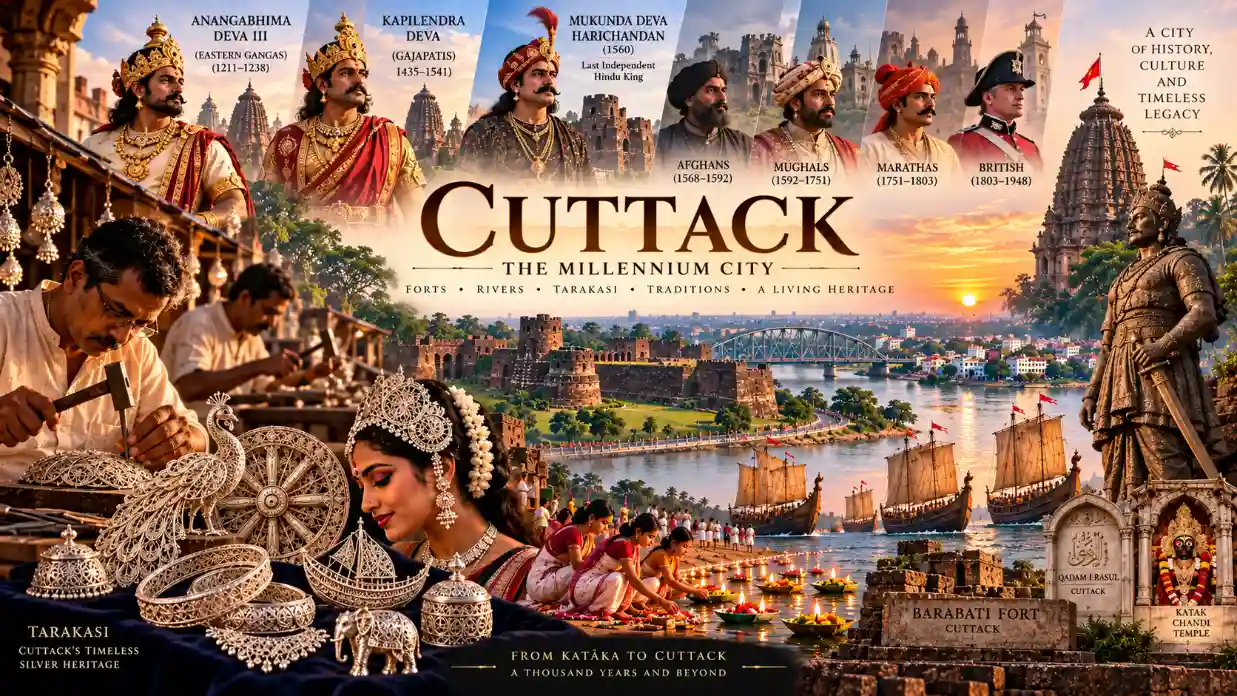
Table of Contents
Every city has a sound that belongs to it alone. In Cuttack it is a very small sound, and you have to be in the right lane to hear it: the tap of a jeweller’s hammer flattening silver wire thinner than a hair, coming from a first-floor workshop above a shopfront in Choudhury Bazar, at seven in the morning, before the traffic drowns it.
That sound is roughly five hundred years old. The lane it comes from is older. And the city those lanes grew inside began, according to the palm-leaf chronicles, as a place to put soldiers.
The Etymology and the Founding
Kataka. The word is Sanskrit and Odia both, and its meanings run in a tight, revealing cluster: an army, a military encampment, a royal camp, and by extension the fort and the seat of power that the camp hardens into. Not a market town. Not a temple town. A garrison — named for the function it was built to perform.
The traditional founding date is 989 CE, and the traditional founder is Nrupa Keshari of the Keshari (Somavamshi) line. The authority for this is the Madala Panji, the palm-leaf chronicle of the Jagannath temple at Puri, and it entered modern historiography through the colonial-era historian Andrew Stirling, who read the chronicle and fixed the date. Cuttack duly observed its millennium in 1989, and “Millennium City” has been the civic byname ever since.
Honesty requires a footnote here, because the foundation is genuinely contested. Some accounts credit Markata Keshari rather than Nrupa Keshari with the original fortification. And a serious scholarly tradition — associated with the late Prof. P. Mukherjee among others — argues that Cuttack as a capital was effectively founded by the Eastern Ganga king Anangabhima Deva III in the early thirteenth century, and that the tenth-century date reflects the chronicle’s habit of pushing origins backward. The likeliest reconciliation is unglamorous and probably correct: a tenth-century military post on a defensible river spit, which two centuries later a more powerful dynasty converted into an imperial capital.
Either way, the name never stopped being literal. Cuttack is the anglicised Kataka. The city is called The Fort, after the fort.
The River Fortress: A City Shaped by Water
Stand on the Ring Road above the Balijatra (Bali Yatra) grounds and the city’s entire logic is visible in one glance. The Mahanadi runs along the north. Its distributary, the Kathajodi, splits away and runs along the south. Cuttack sits on the wedge of land between them, at the apex of the delta, roughly 14.6 metres above sea level.
This is not a site chosen for commerce. It is a site chosen by a soldier. Two rivers form a natural moat on two sides; the confluence guards the western point; an attacking force must either cross water under fire or squeeze into the narrow eastern approach. In the fifteenth and sixteenth centuries the position was reinforced by two rings of subsidiary forts on either bank of the Mahanadi and the Kathajodi — a defensive system that treated the rivers themselves as curtain walls.
The shape this imposed on the city is still the shape of the city. Cuttack is long, narrow and ribbon-like, stretched east to west along the spit because it has nowhere else to go. Its density, its notorious lane-tangle, its habit of building upward and inward rather than outward — all of it descends from a tenth-century decision about defensible ground.
But a moat that protects you also drowns you. The same rivers that made Kataka safe made it perpetually vulnerable to flood, and the city’s second great architectural act is a work of hydraulic engineering rather than fortification. Markata Keshari is credited with raising a stone embankment — a revetment along the Kathajodi’s bank — to hold the water off the new capital, variously dated to 1002 or 1006 CE. Sources disagree on the year and on which bank received the first works, but the significance is not in dispute: within a generation or two of its founding, Cuttack had committed itself to a thousand-year argument with the Mahanadi.
That argument continued through the colonial period’s anicuts and embankment works at Jobra, and was only decisively shifted in the twentieth century by upstream storage at Hirakud. Every winter, when the river withdraws and leaves the vast dry sandbed on which the Cuttack Baliyatra festival is staged, the city is walking on the truce line of that long negotiation.
Dynastic Milestones: Who Held the Fort
The Eastern Gangas and Barabati
The transformation from garrison to imperial capital belongs to Anangabhima Deva III (r. c. 1211–1238) of the Eastern Ganga dynasty. He moved his seat from Choudwar Kataka to the site of present-day Cuttack, renamed it Abhinaba Baranasi Kataka — the New Varanasi — a piece of political theology declaring the capital a sacred city on the model of Kashi, and raised Barabati Fort, conventionally dated to 1229 CE.
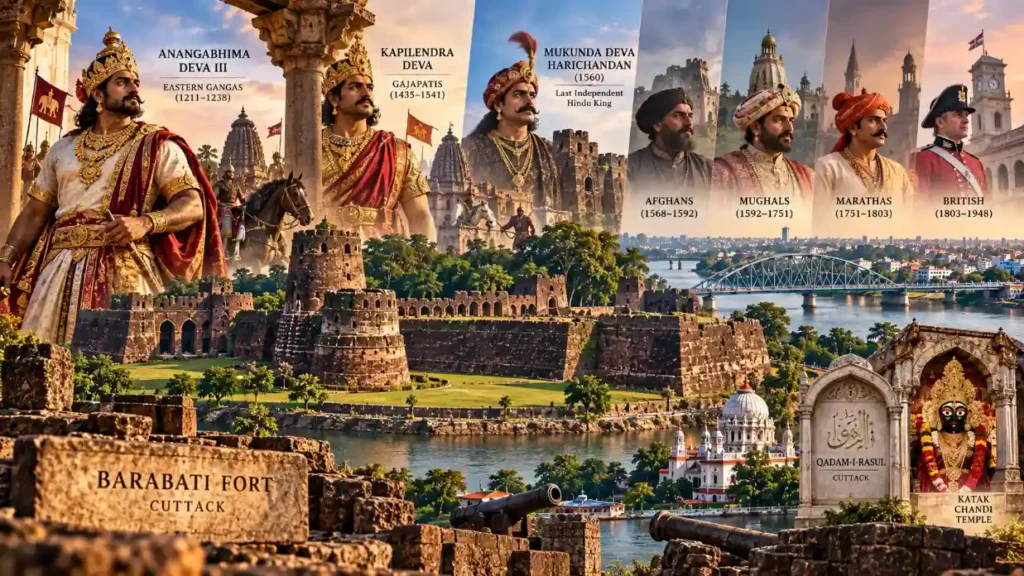
What survives is a ruin, and a moving one: the moat, the gateway, and a great earthen mound where the palace stood. The mound is the ghost of the nine-storeyed building raised within the fort precincts in 1560 by Mukunda Deva Harichandan, the last independent Hindu king of Odisha. It is now a Monument of National Importance under the Archaeological Survey of India, and the Katak Chandi temple — the city’s presiding goddess — stands nearby.
The Gajapatis
Under the Suryavamsi Gajapati dynasty founded by Kapilendra Deva in 1435, Cuttack became the administrative heart of an empire that at its height projected power deep into the Deccan and south toward the Kaveri. This is the high-water mark of Odishan independent statehood, and the period in which the city’s mercantile character consolidated around a stable, wealthy, ceremonious court. Kapilendra’s successors could not hold the expansion, and the dynasty gave way to the Bhois in 1541.
Conquest and Colonial Administration
The independent line ended in 1568, when Mukunda Deva was killed in conflict with Sulaiman Karrani of Bengal. The sequence that follows is a compressed lesson in early modern Indian power: the city passed to the Afghan rulers of Bengal in 1568, to the Mughals in 1592 — after which Cuttack served as the seat of the Subah of Orissa — to the Marathas of the Nagpur Bhonsle line in 1751, and to the British East India Company in 1803.
Each layer left fabric. The Mughal period gave Cuttack Qadam-i-Rasul, the walled shrine complex housing a stone bearing what is venerated as the Prophet’s footprint — still one of the city’s most architecturally coherent monuments and a working centre of its composite culture. The Maratha decades left administrative vocabulary in the street names, which is why one of the city’s principal markets is Buxi Bazar, from bakshi, the paymaster of an army. The British left the grid of civil lines, the courts, the 1919 Bengal–Nagpur Railway connection to Calcutta and Madras, and a Cuttack that was the undisputed administrative and commercial capital of the region.
That primacy formally ended in 1948, when the newly formed state moved its capital to Bhubaneswar. Cuttack kept the Orissa High Court, and with it the standing of judicial capital, and kept — more durably than any statute could confer — its role as Odisha’s commercial nerve centre and its most self-consciously urban city.
1,000+ Years of Kataka
- 989 CE: The Garrison on the Spit A legendary moment is etched in time. King Nrupa Keshari, according to the ancient Madala Panji, establishes a kataka—a military cantonment—on the strategic, narrow spit between the Mahanadi and Kathajodi rivers. While modern scholars debate the exact date, this foundational act roots the city’s identity as a defensive bulwark.
- 1002–06 CE: Markata Keshari’s Great Embankment The city is defined by the water that surrounds it. King Markata Keshari executes a monumental feat of ancient engineering, raising the grand stone revetment to hold back the annual floods of the Kathajodi and secure the fragile peninsula.
- c. 1211 CE: The Capital Shift A new era dawns as Anangabhima Deva III, the great Eastern Ganga monarch, relocates the imperial seat from Choudwar. He sanctifies the new citadel as Abhinaba Baranasi Kataka (the “New Varanasi Fort”) on the river fork.
- 1229 CE: The Barabati Citadel The definitive fortress takes shape. Construction concludes on the monumental Barabati Fort, complete with its deep moats, massive stone gateways, and commanding central palace mound. The citadel is complete, and the city takes its name from it.
- 1435 CE: The Imperial High-Water Mark Under Kapilendra Deva, founder of the Suryavamsi Gajapati Dynasty, Cuttack serves as the capital of a vast empire stretching from the Ganges to the Kaveri. It is the golden age of Odishan political and military power.
- 1560 CE: The Nine-Storey Wonder Sovereignty surges again under Mukunda Deva Harichandan, who constructs the legendary nine-storey palace within Barabati Fort, astonishing foreign chroniclers with its size and architectural detail.
- 1568 CE: The Fall of the Last Hindu Kingdom A dark page is turned. Following the assassination of Mukunda Deva, Cuttack is breached. Independent Hindu rule in Odisha comes to an abrupt end, and the city passes into Afghan rule from Bengal.
- 1592 CE: The Mughal Subah Akbar’s general Raja Man Singh annexes the region. Cuttack is designated the administrative capital (Subah) of the province of Orissa. This period anchors a rich Indo-Islamic heritage, including the beautiful Qadam-i-Rasul shrine complex.
- 1751 CE: The Maratha Garrison City The Nagpuri Bhonsles take control. Cuttack becomes a vital military staging ground; the vocabulary of the camp enters the city’s geography, notably with Buxi Bazar, honoring the Maratha military paymasters and commanders (Buxis).
- 1803 CE: British Possession The British East India Company captures Barabati Fort. Military cantonments give way to colonial civil lines, courts, and major infrastructure works like the Jobra embankment, shifting the city’s growth pattern toward administrative bureaucracy.
- 1919 CE: The Steel Pulse The Bengal–Nagpur railway line cuts through Cuttack, connecting it to Calcutta and Madras and confirming the peninsula’s role as the transportation and commercial core of the region.
- 1936 CE: Capital of the New Province Decades of effort, spearheaded by leaders like Madhusudan Das, culminate. A new, separate province of Orissa is formed based on linguistic lines, and Cuttack naturally takes its place as its capital.
- 1948 CE: Surrendering the Capital Following Indian independence, the state administration is officially moved south to the planned city of Bhubaneswar. Cuttack pivots to become Odisha’s judicial capital, keeping the High Court of Orissa and maintaining its legacy as the constitutional anchor.
- 1989 CE: A Thousand Years Witnessed The Millennium City officially observes 1,000 continuous years of recorded history held between its rivers.
- 2024 CE: The Silver City’s GI Tag The world recognizes the exquisite spun-wire artistry of Cuttack’s master filigree workers. Cuttack Rupa Tarakasi officially receives its Geographical Indication (GI) tag, protecting and preserving its unique, ancient craftsmanship.
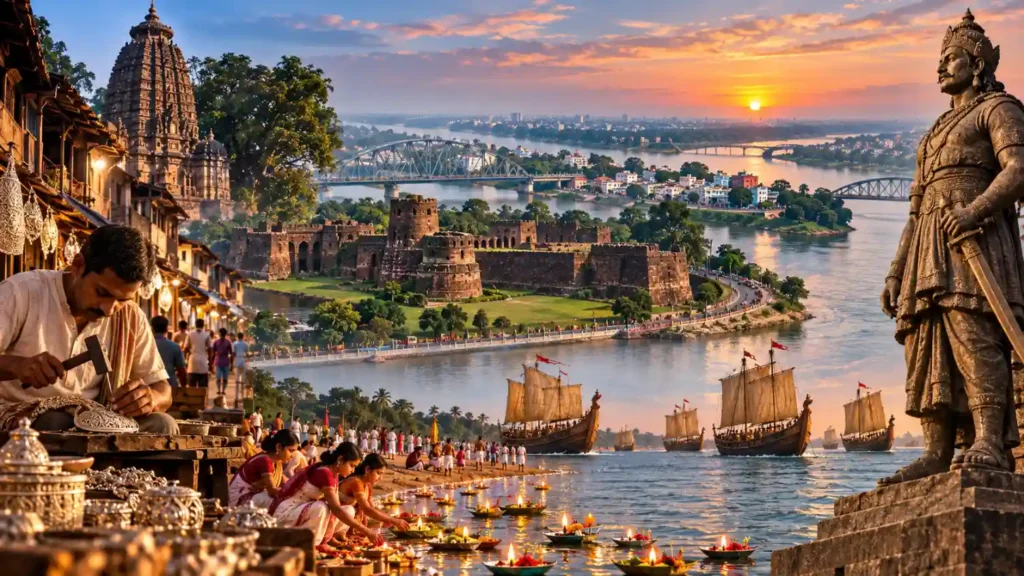
Bawan Bazar, Tepan Gali: The Grammar of the Old Town
Cuttack’s own name for itself is a boast disguised as a complaint: Bawan Bazar, Tepan Gali — fifty-two markets and fifty-three lanes.
The numbers are proverbial rather than surveyed, and that is the point. The phrase is how a city describes a fabric nobody planned. There was no master plan for old Cuttack, because there was no room for one; the spit dictated the axis, the fort dictated the centre, and everything else accreted lane by lane as trades arrived and clustered. The result is the classic pre-modern guild city: a market for a commodity, a lane of the artisans who make it, a lane of the families who have made it for two hundred years, and a temple or a mosque at the junction.
What is remarkable is how legible the medieval logic remains under the modern traffic. Choudhury Bazar is still the address of silver. Naya Bazar — the “new market,” which stopped being new some centuries ago — remains a dense general and wholesale quarter. Buxi Bazar still carries a Maratha paymaster’s title into an entirely commercial present. Balu Bazar, Telenga Bazar, Malgodown, Chandni Chowk, Alisha Bazar, Mangalabag, Dolamundai — each name is a fossil of function, migration or memory, and most are still doing recognisable versions of what they were named for.
Walk them at dusk. The upper storeys lean toward each other, the wiring is a delinquent cat’s cradle, the shopfronts are eighteen inches above a drain, and somewhere in the middle of it a doorway opens onto a courtyard with a tulasi plant and a hundred and forty years of quiet. This is the part of Cuttack that no photograph does justice to, and the part that renovation is quietly deleting. For the food that belongs to these lanes specifically, see must-eat street food of Balijatra Cuttack.
The Historic Bazars of Cuttack
| Bazar / Quarter | Name Origin | Traditional Trade or Guild | Living Character Today |
|---|---|---|---|
| Choudhury Bazar | Choudhury — a title of headship | Silversmiths and filigree workshops | The heart of Tarakasi; workshops above shopfronts |
| Naya Bazar | Naya — “new” (long since not) | General wholesale, provisions | Dense mixed retail and wholesale |
| Buxi Bazar | Bakshi — Maratha army paymaster | Administrative quarter turned market | Commercial hub; educational institutions |
| Balu Bazar | Balu — sand, from the riverbed | Glassware, toys, household goods | Bustling retail quarter |
| Malgodown | Mal godown — goods warehouse | Grain and commodity wholesale | Odisha’s major wholesale grain market |
| Telenga Bazar | Telugu-speaking settlers from the south | Migrant trading community | Old mixed residential-commercial quarter |
| Chandni Chowk | Persianate naming, Mughal-era | Cloth and general trade | Central market street |
| Alisha Bazar | Persianate/Muslim quarter naming | Metalware, hardware | Working trade lanes |
| Mangalabag | Bag — garden; Goddess Mangala | Market grown around a temple node | Major junction and market |
| Dolamundai | Dola — the Dola Purnima swing festival | Festival ground turned quarter | Old residential lanes |
| Oriya Bazar | The Odia-speaking core quarter | Traditional local trades | Netaji’s birthplace museum stands here |
Note: guild attributions reflect long-standing local association rather than formal charter; several quarters have carried more than one trade across the centuries.
Tarakasi: Drawn Silver, and Why the City Is Called Silver
Tarakasi — from the Persian tār-kašī, “wire-drawing” — is the silver filigree work that gave Cuttack its second name, Silver City. The craft is reckoned at more than five hundred years old in this city.
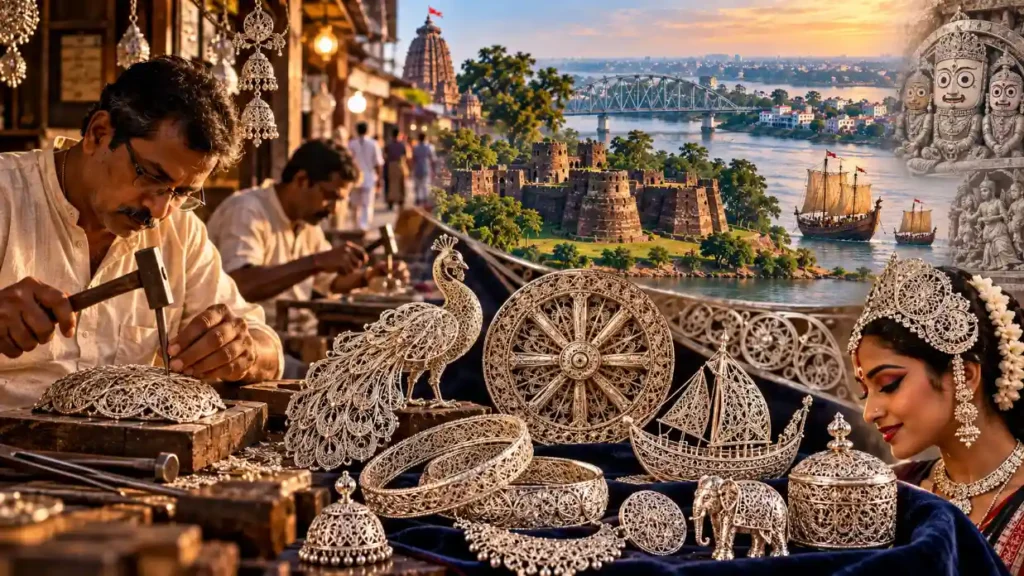
The process is an exercise in controlled patience. An alloy of ninety percent or higher pure silver is melted in a small clay crucible over hot coals, the heat regulated by a hand-cranked bellows. The molten silver is cast into a rod, quenched, then drawn progressively into wire — historically by two men turning a crank against the die, a labour of hours. That wire is drawn again and flattened until it approaches the thickness of a thread, then coiled, twisted, cut and soldered into openwork: filigree so fine that a finished piece reads less as metal than as a drawing suspended in air. Konark’s wheel, Jagannath iconography, scenes from the Mahabharata, boats, peacocks, and the ceremonial tahia headpieces worn in Odissi are the enduring subjects.
The craft’s ancestry is itself a maritime story. Filigree is ancient — it adorned jewellery in Mesopotamia by around 3500 BCE — and its arrival in Cuttack is generally traced through Persia and Indonesia, which is to say along precisely the trade routes the Sadhabas of Kalinga had been sailing for centuries. The Persian name is the surviving fingerprint of that transmission. A city that sent ships to Java received back, among the camphor and the cloves, a technique for making silver look like lace.
In 2024, Cuttack Rupa Tarakasi received the Geographical Indication tag, restricting the name to authorised producers of the region. The protection matters more than it might sound. Filigree is slow, and slowness does not survive contact with machine-stamped imitation unless the law helps. The GI is, in effect, a legal instrument for keeping that seven-in-the-morning hammer tapping in a Choudhury Bazar workshop.
Frequently Asked Questions
1. Why is Cuttack called the Millennium City? Because its traditional founding is dated to 989 CE, giving it more than a thousand years of continuous urban history. The city formally observed its millennium in 1989. The date derives from the Madala Panji, the palm-leaf chronicle of the Jagannath temple at Puri, as read by the historian Andrew Stirling.
2. What does “Kataka” mean, and why was the city given that name? Kataka is a Sanskrit and Odia word meaning an army, a military encampment, or the fort that such a camp becomes. Cuttack is the anglicised form. The city was named for its original function as a garrison on the defensible spit between the Mahanadi and the Kathajodi, and later for the Barabati Fort around which it grew.
3. Who built Barabati Fort and what remains of it? Barabati Fort is conventionally attributed to the Eastern Ganga king Anangabhima Deva III and dated to 1229 CE, though an earlier Keshari-era fortification on the site is also recorded. Surviving today are the moat, the gateway and the earthen mound of the nine-storeyed palace built by Mukunda Deva Harichandan in 1560. It is protected by the Archaeological Survey of India as a Monument of National Importance.
4. What is Bawan Bazar, Tepan Gali? It is Cuttack’s traditional self-description — “fifty-two markets and fifty-three lanes” — capturing the unplanned, guild-based density of its old town. The counts are proverbial rather than exact, but the pattern is real: quarters such as Choudhury Bazar, Naya Bazar, Buxi Bazar and Malgodown still carry the trades and the names that medieval and early-modern commerce assigned them.
Bhubaneswar got the secretariat. Cuttack kept the courts, the commerce, the silver, the Durga Puja, and the river. Which of those is a capital city is a matter of opinion, and in Cuttack the opinion is settled.